Eric McClellan, a pediatric cardiac intensivist who joined our lab a couple of years ago to pursue research alongside his clinical career, attended the Pediatric Academic Societies (PAS) meeting in Toronto, Canada. The PAS meeting brings together a diverse group of pediatric professionals, including clinicians and researchers from a wide range of specialties. There, he presented his abstract titled “Ventricular geometry maintains normal radius of curvature and wall thickness in a novel hypoplastic left heart model in fetal sheep.”
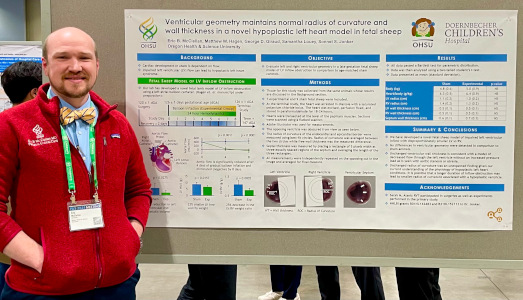
In his research, Eric explores how the shape of the heart’s ventricle—specifically the radius of curvature—affects wall stress, the mechanical force exerted on the heart muscle cells as they work to pump blood. A larger radius of curvature increases wall stress, as does a thinner ventricular wall. Maintaining a normal radius and wall thickness helps ensure that the heart muscle doesn’t become overloaded, which is particularly important in conditions like hypoplastic left heart syndrome (HLHS).
Using a novel fetal sheep model of HLHS, Eric’s work investigates how the geometry of the ventricle adapts during development. This model offers valuable insight into how structural changes in HLHS impact heart function and contribute to increased wall stress. By better understanding these factors, we aim to identify potential therapeutic targets that could improve heart health in affected infants.