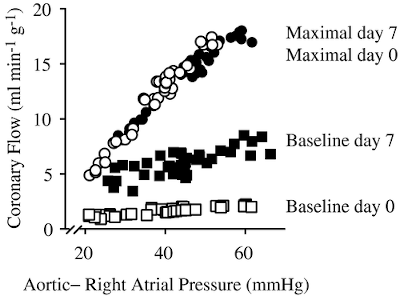
The coronary arteries are what supplies oxygen to the working muscle of the heart. We can increase the amount of heart muscle in the fetal sheep by giving it IGF-1. In this study, we asked how the coronary arteries change when we grow the fetal heart with IGF-1. We found that the coronaries grew proportionally to muscle growth, and continued to function normally.
We also looked at what “normal function” means in the fetal coronaries. We found that two signaling molecules were largely responsible for the increased in coronary blood flow when the fetus is challenged by low oxygen: adenosine and nitric oxide.
Given the role that coronary arteries play in adult disease, and the role of development in determining adult disease, it’s critically important to address these questions.
It wouldn’t be a good research study if it didn’t raise more questions to answer, and one question that we’re now pondering is what’s going on in the hypoxic fetal myocardium when oxygen delivery per work decreases steeply without a reduction in cardiac work.
Read the paper at The FASEB Journal or find it on Pubmed.